If you’re staying in Dubai for more than a few weeks, the real question isn’t whether to rent long-term — it’s which term. A 3-month plan, a 6-month plan, and a 12-month plan don’t just differ in length. They come with different monthly rates, different flexibility, and different break points where one stops making sense and another takes over.
Get the term wrong, and you either overpay for flexibility you don’t need or lock into a full year when your plans might change in four months. This guide breaks down real 2026 numbers for each option, who each one actually suits, and how to negotiate a better rate than the sticker price — whichever term you land on.
Quick answer: 12-month rentals offer the lowest monthly rate in Dubai — typically 20–30% below the 1-month price. Six-month rentals are the sweet spot for most relocating professionals, saving 15–20% without a full year of commitment. Three-month rentals suit anyone on a fixed-length assignment or visa process, saving 10–15% while still costing far less than a daily rental. As a rule of thumb: if you’re certain you’re staying more than six months, 12 months wins on price. If there’s any chance your plans change, the smaller discount on a 3- or 6-month term is worth the extra flexibility.
What Actually Counts as “Long-Term” Car Rental in Dubai?
In the Dubai rental market, “long-term” generally means anything from three months upward — distinct from daily and weekly rentals (built for tourists and short trips) and from open-ended monthly rentals, which roll indefinitely with no fixed end date.

A long-term plan is a fixed-length agreement: you commit to 3, 6, or 12 months upfront in exchange for a lower monthly rate — the same logic as a longer stay at a serviced apartment costing less per night than a one-off booking.
The trade-off is simple. The longer the commitment, the deeper the discount, but the less flexible your exit. That’s the entire decision in one sentence — everything below just fills in the numbers and the “who’s this actually for” detail.
3 vs 6 vs 12 Months: Side-by-Side 2026 Pricing
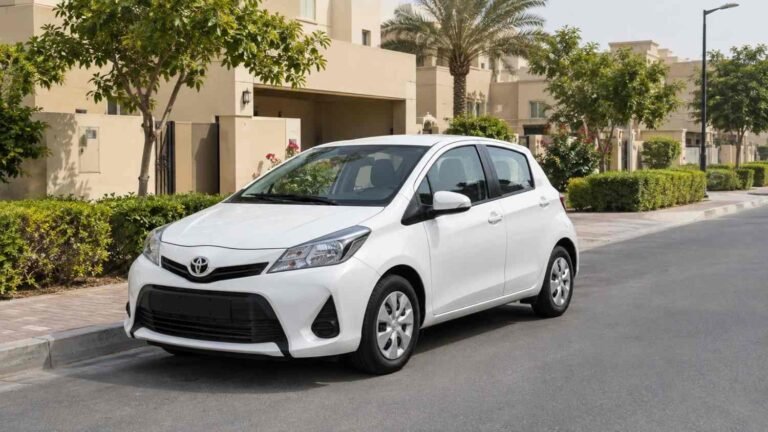
| Rental Term | Entry Hatchback (e.g. Toyota Yaris / Kia Picanto) | Popular SUV (e.g., MG-ZS) | Typical Savings vs. 1-Month Rate |
| 1 month (standard rate) | From AED 1,199/month | From AED 1,825/month | — |
| 3 months | From AED 1,050/month* | From AED 1,600/month* | ~10–15% |
| 6 months | From AED 999/month* | From AED 1,500/month* | ~15–20% |
| 12 months | From AED 899/month* | From AED 1,350/month* | ~20–30% |
Indicative starting rates based on published BVCAR rates and standard long-term discount tiers. Confirm exact current pricing on WhatsApp, as it varies by vehicle condition, season, and availability.
The pattern holds across the fleet: every extra block of committed months buys a deeper discount, but the biggest jump in savings happens between 3 and 12 months — not between 1 and 3. Going from a 1-month to a 3-month commitment saves you a bit; going from 3 months to 12 saves you a lot more, for a proportionally smaller increase in commitment. That’s the number that should actually drive your decision — not simply whether 12 months beats 1 month, because it always will.
Who Should Choose Each Plan?
3 Months — Best for Fixed-Length Stays
For anyone on a visa run, a short-term secondment, a fixed-length home renovation, or simply “trying Dubai” before deciding whether to relocate for real, three months is the natural fit. You get a meaningful discount over the 1-month rate without betting on a future you’re not sure about yet. It’s also the right call while you’re between longer-term decisions — waiting on a permanent residence visa or a company car allowance to come through, for example.
6 Months — The Sweet Spot for New Residents
This is where most relocating professionals land, and for good reason. Six months unlocks most of the meaningful discount — roughly 15–20% off the 1-month rate — while still giving you an exit point well before a full year. That matters if you’re not yet sure whether you’ll buy a car, extend your visa, or move on. It’s also a realistic window to test a specific car model before deciding whether to commit to owning one.
12 Months — Maximum Savings for Committed Residents
If you already know you’re in Dubai for the year — a confirmed job contract, a settled family relocation, a long-term project — 12 months is very hard to beat on price. You’re looking at 20–30% off the standard monthly rate, which on a popular SUV can mean saving several hundred dirhams every single month compared to a 1-month booking. The only real risk is locking in before you’re sure, so this term rewards certainty more than any other.

Not Sure Yet? Start Shorter, Not Longer
If you’re genuinely undecided, the safer mistake is starting with a 3-month term and extending it once you’re confident, rather than locking into 12 months and needing to exit early — which is where early-termination fees typically apply.
What’s Included—and What Isn’t
Every long-term rental includes comprehensive insurance, a set mileage allowance, and 24/7 roadside assistance as standard — the same baseline as a monthly rental, just at a lower rate for committing longer. One detail worth paying attention to, whatever term you choose, is your mileage package.
Most Dubai rental companies default renters into a higher mileage tier than they actually need. If your daily driving is a straightforward home-to-work commute — Dubai residents typically drive 50–70 km a day — a lighter mileage package (BVCAR offers plans built around roughly 2,500 km/month) usually costs less than an unlimited-mileage plan you’ll never fully use. It’s worth doing the rough math on your own routine — daily commute times 22 working days, plus a buffer for weekends — before defaulting to the biggest package on offer.
What’s typically not included, on any long-term plan, anywhere in Dubai: fuel, Salik toll charges, parking, and traffic fines. These are billed based on actual usage, not baked into the rental price. Ask for the full, itemized “total out-the-door” figure — rental plus expected monthly extras — before signing, so the number you budget for is the number you’ll actually pay.
How to Get the Best Long-Term Rate
A few things move the needle more than people expect:
- Book direct. Contacting a rental company directly by phone or WhatsApp, rather than through a comparison site, often unlocks a better rate than the publicly listed price, since the company isn’t paying a referral commission on the booking.
- Ask — don’t assume the sticker price is final. Long-term rates are frequently negotiable, especially for 6- and 12-month commitments. It’s entirely reasonable to name a target monthly figure and ask if it’s workable.
- Time it right. Rental demand in Dubai eases during the hotter summer months, which is typically when the best long-term rates are on offer. Booking in June–August, if your timeline allows it, tends to beat booking in the October–April peak season.
- Match the mileage package to your actual driving, not the default option — this alone can be one of the larger line-item savings on a long-term contract.
- Get everything in writing before you pay a deposit — the monthly rate, what’s included, the mileage cap, and the early-termination terms — so there are no surprises three months in.
Frequently Asked Questions
Is a 12-month car rental actually cheaper than twelve separate 1-month rentals?
Yes, meaningfully so. A 12-month term typically runs 20–30% below the standard 1-month rate, which compounds to a significant saving over a full year compared to re-booking month to month at the higher rate each time.
Can I switch cars partway through a long-term rental?
This depends on the provider’s contract terms. Many allow a vehicle swap partway through a long-term agreement, typically for a small administrative fee — confirm this before signing if it matters to you.
Do I need a UAE driving licence for a long-term rental, or is my home country licence enough?
UAE residents need a valid UAE driving licence. Visitors and new arrivals can typically rent on a home-country licence for a period — an International Driving Permit is recommended, and required for some nationalities — before a UAE licence becomes necessary.
What happens if I need to end a long-term rental early?
Early termination is usually possible but may carry a fee, since the monthly rate was priced assuming the full term. Always check the early-exit clause before signing — it’s one of the most important lines in a long-term contract.
Is a security deposit required on long-term rentals?
Yes, typically. A refundable deposit is standard across the Dubai rental market regardless of term length, returned after the rental period once any tolls, fines, or damage costs are settled.
Is it cheaper to rent long-term or buy a car in Dubai?
For stays under roughly 3–4 years, renting long-term is usually the cheaper and lower-hassle option once depreciation, insurance, and registration are factored in. Buying tends to only pull ahead for those settling in permanently.
Find Your Number, Not a Guess
The honest way to find out which term actually saves you the most is to run your specific numbers — your expected stay length, your daily driving distance, and the car you have in mind — rather than guessing. BVCAR’s team will do that math with you directly over WhatsApp, usually within half an hour, with no obligation and no pressure to commit to a longer term than you actually need.
📱 WhatsApp now: +971 52 560 7472 — share your rough dates and the car you’re considering, and ask for a 3-, 6-, and 12-month comparison side by side.
🌐 Browse the current fleet and live rates: bvcardubai.com/rent-a-car-in-dubai